

Azoth
The Apophenia Machine

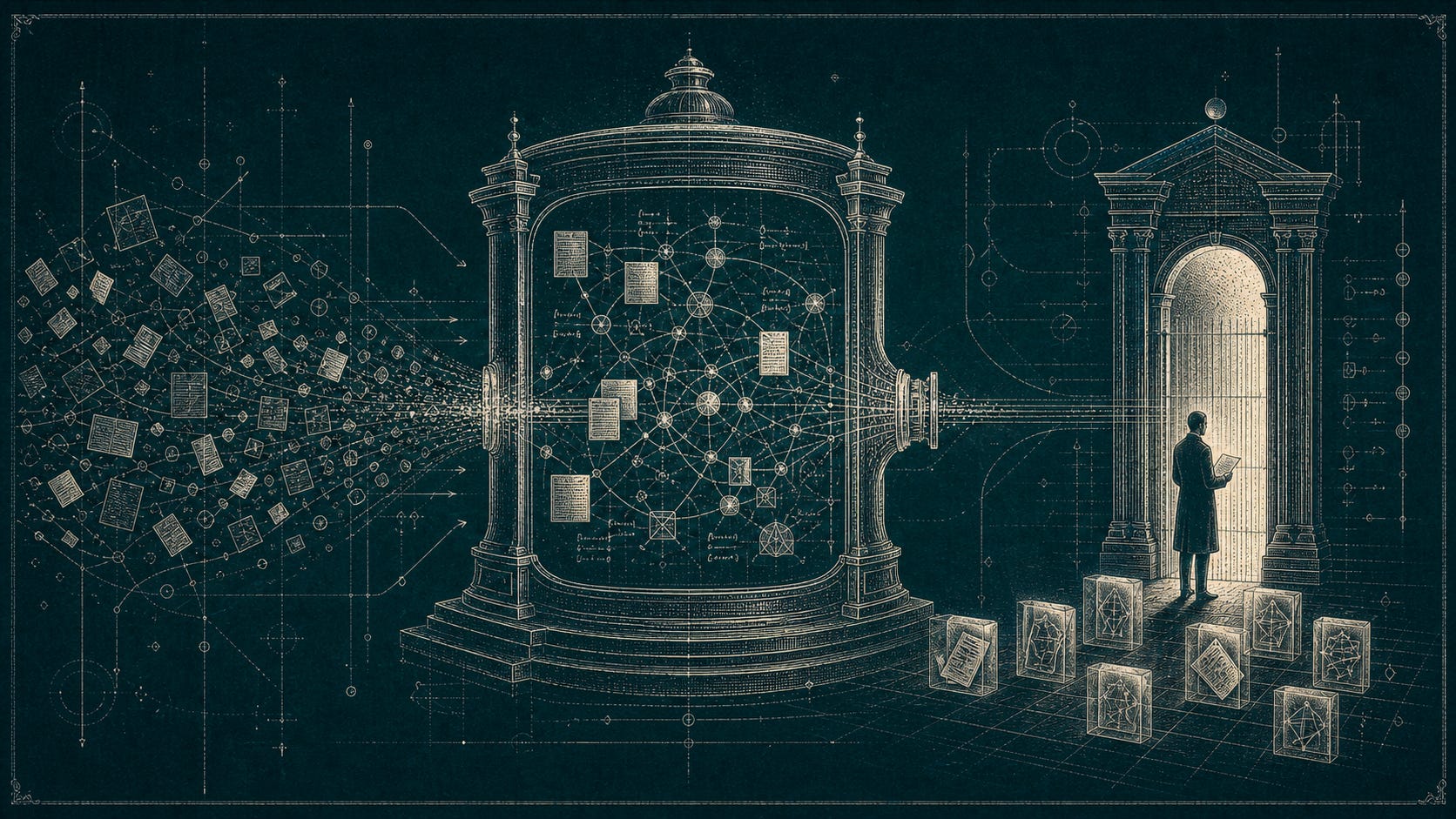
Anastomosis was the name I gave to a pattern I had been living before I knew how to describe it.
The Hub Intelligence Initiative, the Market-Shadow, the Memory Layer, the theory work, the old fragments, the logistics dashboards, the falsified trading hypotheses, the mathematical notes that kept circling the same boundary from different directions: none of these were the same project, but none of them were separate either. They were passages between systems that had to remain distinct. Logistics could not become finance. Finance could not become philosophy. Philosophy could not become machine learning. But something moved between them.
That movement was the content.
Anastomosis named the passage. Biological, surgical, concrete. Vessels reconnecting without dissolving into each other. A connection that permits flow while preserving boundary.
Azoth is the next thing: not the passage between my projects, but a machine for making passages inside a research library.
I need to be precise about that sentence. Azoth is not a machine that discovers truth. It is not an autonomous scientist. It is not a replacement for reading, judgment, taste, discipline, or the slow humiliation of realizing that the beautiful connection you thought you found already exists in a paper you had not read. Azoth is a locally runnable research synthesis engine. It ingests papers, turns them into structured records, expands those records into derivations and missing angles, searches for structural connections across the library, and surfaces candidate gaps.
Everything it produces is a candidate.
That is the first rule. The machine surfaces. The human decides.
The repo is called the Apophenia Machine because that is what it does and because that is the danger.
Apophenia is usually treated as pathology: seeing patterns where no pattern exists. Faces in clouds, conspiracies in coincidences, secret messages in noise. I know this danger intimately. Some of my early writing was alive because it could connect what was not supposed to connect. Some of it was weak for the same reason. The method finds patterns whether or not they are there.
That sentence is the wound the project is built around.
The question is not whether apophenia is good or bad. The question is what disciplines it. A mind that cannot connect across domains is trapped in departmental geometry. A mind that connects without gates becomes decorative, paranoid, or useless. The work is to keep the generative power while refusing the lie. To let the curved path move, but force it to leave evidence behind.
Azoth is that discipline made operational.
It takes the dangerous faculty, the one that sees a connection between a machine learning regularizer and a theological distinction and a pedagogical method and a theorem about boundary information, and it asks: where is the source? what is the claim? what is the confidence? does this follow, or is it only suggestive? has the novelty already been killed by prior art? what would test it? what must return to the black mass before it can be named again?
This is not metaphor. It is workflow.
The Names
Azoth is an alchemical name: the universal solvent, the Alpha-Omega unity, the thing that dissolves all boundaries without destroying what it touches. In the project, Azoth names the whole engine.
Apophenia names the act.
The project is Azoth. The operation is apophenia. Together: the Apophenia Machine.
That distinction matters because the repo is full of names that look mystical until you understand their function. Nigredo. Albedo. Citrinitas. Rubedo. Athanasor. Lapis. Vigil. Codex. These are not ornaments. They are not there to make a Python package seem profound. They are a memory system for the user, a way of making the phase structure legible without flattening it into sterile pipeline language.
But the machine interfaces stay plain.
The directories are alchemical because the user needs to inhabit the process. The schema fields are English because machines need to parse them. paper_id, status, source, tags, confidence: these are not places for poetry. The command line uses verbs: ingest, awaken, connect, detect, draft, triage, review, experiment, promote, ouroboros. The surface can carry myth. The payload cannot.
This is one of the disciplines I did not always have when I was younger. I used to let the density do too much work. A word would become a private shrine, a cluster of references, a signal to anyone who had read the same books. Sometimes that was necessary. Sometimes it was hiding. Azoth cannot hide like that because it has to run. If the name does not map to a directory, a schema, a gate, a state transition, or a command, it is decoration. If it is decoration, it does not belong.
The alchemical map is simple.
Nigredo is the blackening. The undifferentiated mass. In the repo, this is raw intake: PDFs, text files, markdown, arXiv references where supported, dropped into nigredo/inbox/ or into a domain folder like nigredo/ML, nigredo/physics, nigredo/philosophy, nigredo/mathematics, nigredo/neuroscience.
Before anything can be known, there is a pile.
Albedo is whitening, purification, the first light. In the repo, this is structured extraction. The raw paper becomes a YAML record in albedo/library/. Its claims are separated from its methods. Its techniques are named. Its equations are preserved as anchors. Its caveats are written down. The registry, albedo/registry.jsonl, records the processing state.
A paper stops being a PDF and becomes a node.
Citrinitas is yellowing, dawn, the moment when pattern becomes visible. In the repo, this is connection discovery. Azoth compares exhausted papers within a domain or across domains and writes connection records into citrinitas/within_domain/ or citrinitas/cross_domain/. It is not looking for keyword overlap alone. It is looking for structural relation: methodological overlap, analogous structure, contradictory claims, shared assumptions, missing citations, complementary techniques.
This is where apophenia becomes useful and dangerous.
Rubedo is reddening, completion, the Stone. In the repo, this is where hypotheses appear: gap reports, drafts, triage packets, reviews, experiment specs. Rubedo is not the place where truth is declared. It is the place where candidates become concrete enough for human judgment. A gap becomes a file. A draft becomes editable. A proposed experiment becomes something a researcher can inspect, reject, modify, or run.
Athanasor is the furnace. The vessel. The infrastructure that makes transformation possible. In the repo, this is athanasor/: the CLI, config, LLM abstraction, embeddings, PDF parser, registry logic, schemas, skills, session machinery, memory, gates. Without Athanasor, the alchemical phases would be folders and vibes. With it, they are operations.
Inside Athanasor there is Vigil.
Vigil is the guardian flame. It enforces gates. It checks drift. It blocks invalid states. It asks whether claims are backed by artifacts, whether cross-domain connections are genuine, whether speculative derivations have exceeded their ceiling, whether exhausted matter is being reprocessed without explicit instruction, whether rejected candidates are resurfacing without new evidence.
This is the part of the machine I trust most because it is the part designed to distrust the machine.
Lapis is durable state. Codex is handoff. The machine remembers what has been processed, what has been connected, what the next session inherits. Not memory as mystical continuity. Memory as files on disk: state.json, codex.md, checkpoint JSONL, registry rows. The point is not that the machine has a soul. The point is that research work fails when context evaporates. Lapis and Codex are anti-evaporation devices.
The First Cycle
You do not have to understand the whole architecture before touching it. The first useful cycle is small.
The first cycle begins before any paper enters the furnace. If you are terminal-native, that means the ordinary local ritual: clone the repo, create the Python environment, install the package, check pdftotext, and point Azoth at an LLM backend.
If you are using a coding agent, much of that can be delegated. The agent can create the environment, install the repo, check the dependencies, inspect the LLM configuration, run azoth --help, and begin with python3 scripts/incipere.py.
But the agent cannot supply the missing world by itself. It cannot invent an API key. It cannot install a local model that does not exist on your machine without asking. It cannot know where your private papers are unless you point to them. It cannot make pdftotext available if your system blocks the dependency. At those boundaries, it should stop and tell you what is missing.
That is already part of the discipline. No silent setup. No hallucinated readiness. No pretending the furnace is lit.
Once the furnace is lit, the first motion is simple:
python3 scripts/incipere.py
cp ~/Downloads/paper.pdf nigredo/inbox/
azoth ingest nigredo/inbox/
azoth awaken ML --depth 3 --count 3
azoth connect --within ML
azoth detect --domain ML
azoth draft --top 1
azoth triage <cluster_id>
azoth review <cluster_id>
azoth experiment <cluster_id>
That block is not the whole system. It is the smallest motion that lets you see what the system is.
A paper enters Nigredo as undifferentiated matter. Ingest runs Separatio, the act of classification. The paper is assigned to a domain, moved into the right folder, extracted into YAML, and recorded in the registry. It becomes Albedo: a structured object with claims, methods, techniques, caveats, equations, tags, and source metadata.
Then a domain is awakened.
The word matters. Domain subagents are dormant. They do not run autonomously. They sleep until called. If you awaken ML, it processes a bounded slice of ML papers. If you awaken philosophy, it processes philosophy. You can set the depth. Depth 1 is skim. Depth 3 is thorough. Depth 5 is obsessive, expensive, and should be treated like any obsessive act: sometimes necessary, often avoidance.
Awakening exhausts papers. Exhaustion asks what follows from a structured record. For a technical paper, this might mean derivations, implications, missing experiments, unstated assumptions. For a textbook, exercises and corollaries. For philosophy, missing angles, counterarguments, necessary connections, hidden load-bearing assumptions. For pedagogy, it may surface the implicit model of learning the paper assumes but never names.
Then Citrinitas connects. It compares exhausted papers, prunes the pair space through tags and embeddings, and asks whether two works share a structural relation worth inspecting.
The naive comparison of every paper to every other paper scales quadratically.
A personal library of a thousand papers contains nearly half a million pairs.
Most are useless. The machine must prune or it becomes a theater of wasted calls.
Then Rubedo detects gaps and drafts notes.
Not “what does one paper say?” but “what question do these papers collectively orbit that none of them answers?” That is the research move. A library becomes more than storage when its internal absences become visible.
But even then, nothing is complete. A draft is not a paper. A gap is not a discovery. A confidence score is not evidence. The important commands come after generation: triage, review, experiment, promote. The machine can prepare the packet. It cannot absolve the human.
This is the difference between a research engine and a slop generator.
Ouroboros
The most important loop in the project begins with failure.
Suppose Rubedo surfaces a candidate gap. It looks promising. The connection is elegant. The papers do not cite each other. The hypothesis is specific enough to test. Then prior-art review finds the work already exists, or finds a nearby literature that dissolves the novelty claim, or finds that the machine’s frame was too narrow.
The bad version of this workflow would delete the candidate and move on. That is how research systems become amnesiac. They treat rejection as waste.
Azoth does something else.
It runs Ouroboros.
azoth ouroboros <cluster_id>Ouroboros reads the prior-art record, writes an expansion plan and report into nigredo/ouroboros/, and can safely download arXiv or direct-PDF sources into nigredo/inbox/. It does not auto-ingest them. It does not mutate the Rubedo decision. It does not quietly rehabilitate a rejected hypothesis.
It returns mapped territory to raw intake.
This is exact. The failed claim is not resurrected. The evidence that killed it becomes part of the next corpus. The system does not pretend that rejection was success. It asks what the rejection teaches the library.
The machine does not get smarter. It gets better-fed.
That distinction matters: “Smarter” hides the mechanism. “Better-fed” names it. The next pass is better because the corpus is richer, the prior art is closer, the library has absorbed the boundary that stopped the previous claim. New Nigredo becomes better Albedo. Better Albedo makes better exhaustion possible. Better exhaustion makes less naive connections possible. Less naive connections make Rubedo more honest.
The snake eating its tail is not mystical decoration. It is the research loop that prevents failed novelty from disappearing.
A clean failure becomes material.
The Agent as Operator
Once the repo is runnable, there is another way to use it, and for many people it will be the more natural one.
You do not have to become fluent in the command line before the machine becomes useful. You can clone the repo, open it inside a coding agent, and point the agent at the operating files: README.md, USER_GUIDE.md, AGENTS.md, AESTHETIC.md, and the schemas. Then the agent becomes the hand on the furnace. It can run the commands, inspect the artifacts, explain what changed, and help create repo-local operating skills for your own domain.
But this does not remove the gates. It only changes the interface.
The agent should not “discover” for you. It should operate Azoth under the same constraints: ingest only the material you authorize, leave generated outputs in pending_review, validate schema files, explain failures, and ask before promotion. The command line becomes less visible, but the discipline remains the same.
If I were handing the repo to an agent, I would begin with something like this:
You are operating Azoth, the Apophenia Machine, inside this cloned repo.

First read:
- README.md
- USER_GUIDE.md
- AGENTS.md
- AESTHETIC.md
- SCHEMA.yaml
- EXHAUST_SCHEMA.yaml
- CONNECT_SCHEMA.yaml
- DETECT_SCHEMA.yaml

Rules:
- Do not claim discovery, proof, or confirmation.
- Treat all generated outputs as candidates.
- Preserve pending_review unless I explicitly approve promotion.
- Use the repo's existing commands and schemas.
- Run validation after substantive changes.
- Explain what artifacts were created or changed.
- Ask before ingesting new material, promoting a hypothesis, or modifying gates.

Start by running python3 scripts/incipere.py, summarize the current state, and propose the smallest useful next cycle.
This matters because the user of Azoth may not be a terminal-native engineer. They may be a philosopher, historian, teacher, independent researcher, artist, or scientist whose real fluency is in the material, not in shell commands. That should not exclude them. The point is not to make everyone love the CLI. The point is to make the research process inspectable.
A coding agent can become the operator. Azoth remains the vessel.
Who This Is For
The obvious user is someone working with machine learning papers. That is where a lot of the current technical surface points: embeddings, representation learning, world models, schema-bound extraction, LLM backends. But the project is not an ML paper machine. It is a research synthesis machine.
I imagine someone whose library is not cleanly departmental. A folder where Mark Fisher sits beside cybernetics, psychoanalysis, and political economy. Where James C. Scott sits beside logistics, legibility, state capacity, and supply chains. Where Korzybski sits beside Shannon, Boltzmann, and Chris Fields, and the question is always where knowledge ends and projection begins. Where Anna Tsing sits beside ecological disturbance and distributed systems. Where Kim Stanley Robinson sits near climate modeling, political economy, terraforming, and the pedagogy of possible futures.
None of these belong to one domain. That is the point.
A philosopher can use Azoth to ingest phenomenology, philosophy of mind, cognitive science, machine learning, and theology, then ask where the same structural problem appears under different names. A teacher can use it on pedagogical papers, lecture notes, curriculum theory, assessment research, and classroom notes, then ask which assumptions about learning are repeated without being tested. A historian can use it to track institutional patterns across archives, theory, economic history, and political documents. A mathematician can use it to turn papers and monographs into structured claims, techniques, exercises, and open questions.
A solo researcher can use it the way a lab uses people: not to replace judgment, but to keep parallel tracks from collapsing into one exhausted mind.
This is the material condition the project responds to. The modern solo researcher has access to more text than any individual can metabolize. PDFs accumulate. Notes fragment. Connections flash and disappear. A paper read in March becomes a vague memory by July. A beautiful analogy remains private because it never becomes a file, a record, a hypothesis, a test, a rejection.
The library is not passive. It is undigested.
Azoth does not solve the problem of understanding. It gives understanding a set of operations.
Drop the paper into Nigredo. Extract it into Albedo. Exhaust it. Connect it. Detect the gap. Draft the note. Triage the claim. Review the evidence. Design the experiment. Promote, reject, or return it to the black.
This is not glamorous. Good. Most real research is not glamorous. It is moving carefully between excitement and embarrassment. It is finding a pattern and then trying to kill it honestly. It is being glad when the pattern survives, and almost as glad when it dies cleanly because a clean death preserves time.
The Human Gate
The strongest part of Azoth is not that it uses AI.
Everyone uses AI now. Most usage is just a faster way to produce prose-shaped uncertainty. The strongest part of Azoth is the refusal to let prose become authority.
The source of truth is not the model response. The source of truth is the artifact: the paper, the equation, the method, the citation, the schema-validated record, the human decision. Agent prose is not evidence. This is written into the gates:
Corpus says claims must be embodied.
Coniunctio says connection is not coincidence.
Calcinatio says speculative derivation must be marked as speculative.
Caput Mortuum says exhausted matter should not be reprocessed as if the machine forgot.
Nigredo Redux says rejected candidates must not return without new evidence.
These are not philosophical moods. They are checks.
The schemas matter for the same reason. SCHEMA.yaml forces a paper record to contain structural claims, methods, techniques, equations, caveats, explicit connections, tags. EXHAUST_SCHEMA.yaml distinguishes derivations from exercises, missing angles, open questions, unstated assumptions. CONNECT_SCHEMA.yaml requires connection type, evidence from both sides, confidence, novelty framing, significance, status. DETECT_SCHEMA.yaml requires candidate gaps with supporting papers, supporting evidence, feasibility, confidence, and suggested approach.
The machine has to put its thoughts somewhere.
That “somewhere” is what makes review possible. A vague chat answer cannot be audited. A YAML record can. A draft note can. A registry transition can. A failed validation can. A command with stderr can. A checkpoint can. A prior-art file can.
This is why the project is local-first and model-agnostic. The model matters, but it is not the project. The project is the structure around the model: the bounded commands, the files, the review states, the gates, the memory, the refusal to confuse fluent synthesis with knowledge.
The default state is pending_review.
That phrase is the moral center of the repo.
Not confirmed. Not discovered. Not validated. Pending review.
I have spent enough time with systems, institutions, markets, models, and my own pattern-hungry mind to know that the first story is usually too clean. The first connection is often a projection. The beautiful bridge may be made of fog. The machine must therefore be built to disappoint itself.
This is what separates Azoth from the fantasy of automated research. Automated research wants the machine to generate papers. Azoth wants the machine to generate reviewable candidates, and then shut up long enough for the human to inspect them.
There is dignity in that limitation.
The Furnace
When I look back at the old substack now, I can see that apophenia was already there. I was connecting misspellings, koans, Joyce, political economy, thermodynamics, cybernetics, Deleuze, Marx, bodies, tools, light, infrastructure. Some of those connections were real. Some were not. More precisely: some survived later discipline, and some did not.
Azoth is what happens when that old faculty is not abandoned but put inside a furnace.
The furnace does not remove the wildness. It gives the wildness walls.
A research library enters as black matter. The machine separates it, purifies it, wakes it, connects it, reddens it into candidate work, and then asks the human to decide what deserves to survive. If the work fails, it returns to the beginning with more knowledge than before. If it survives, it still survives as a human responsibility.
This is the only way I know how to use AI.
Not oracle. Not collaborator in the sentimental sense. Not replacement mind. A tool, a vessel, a pressure system, a gate-bound engine for making the invisible structure of a library easier to inspect.
The reader I imagine is not a company. Not a lab with a grant and a staff and a polished knowledge management platform. I imagine one person with too many PDFs, too many notes, too many half-remembered connections, too much desire to understand, and not enough institutional surface area to hold the work. Someone reading machine learning at night and political theology in the morning. Someone teaching and researching at the same time. Someone with a folder called “papers” that has become a private weather system. Someone who keeps seeing the same structure appear in different costumes and wants to know whether that perception is real.
Azoth will not answer that for you.
It will help you ask it better.
It will take your library seriously enough to decompose it. It will take your pattern recognition seriously enough to test it. It will take your failures seriously enough to remember them. It will leave claims pending until you decide what the evidence can bear.
That is the invitation.
Clone it. Feed it one small folder. Or open it with the coding agent you already use, give the agent the operating files, and let it tend the furnace under constraint. Run one cycle. Reject what does not survive contact with evidence. Keep what remains in motion.
The machine is not the Stone.
The machine is the furnace.